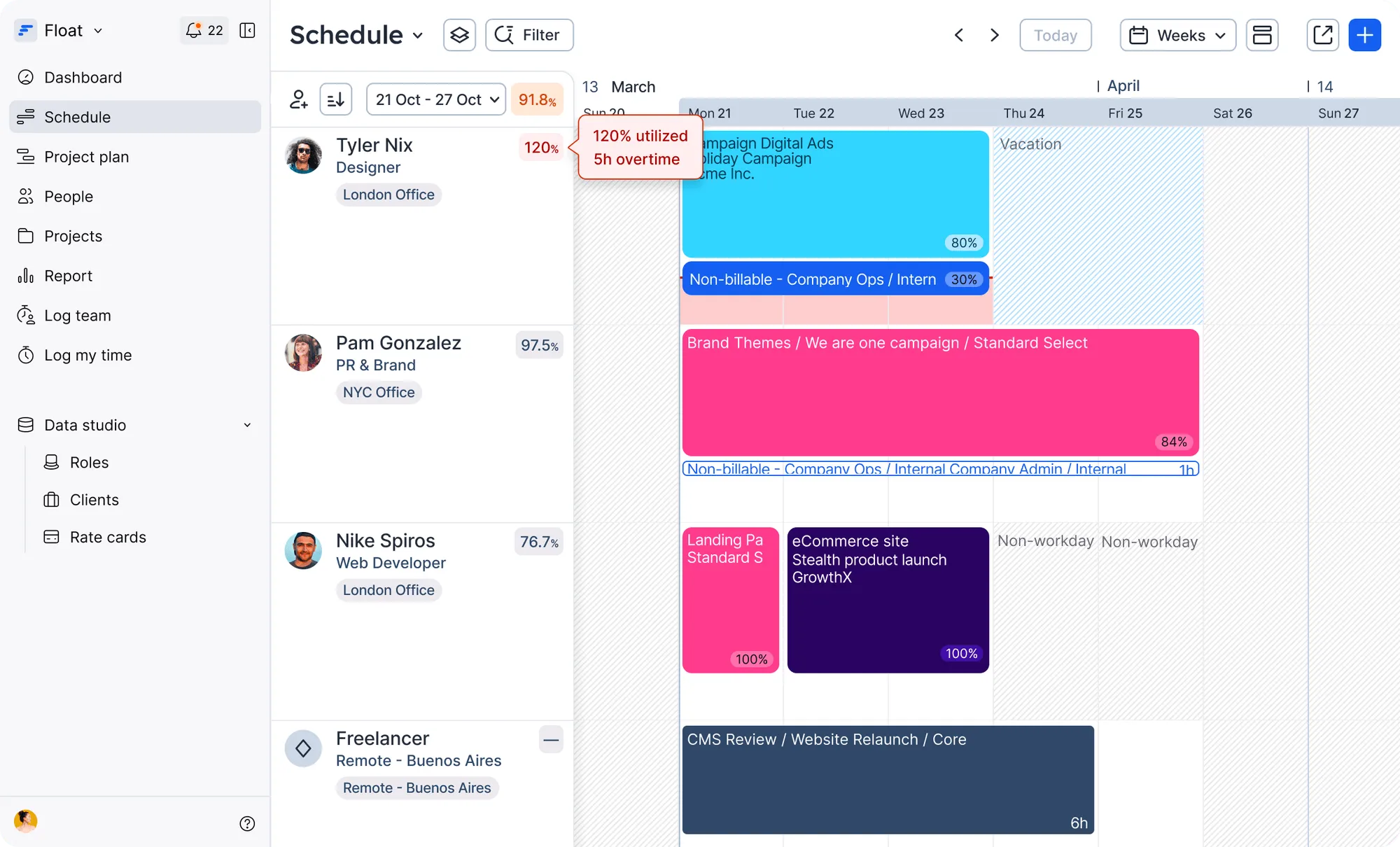

Let me get the obvious answer out of the way: yes, you can build your own resourcing app. The impulse is great: it means you understand your own workflows well enough to spec what you need. Plus, custom internal builds have become easier with Claude, Cursor, Lovable, or Replit. You can probably vibe-code something in a weekend that’s a serious step up from a spreadsheet; you might even get to something robust enough to replace a dedicated scheduler.
If scheduling (the drag-and-drop, who’s-on-what part) is all you’re looking for, definitely give it a try. But scheduling is the easy 20% of what a resourcing system has to do. The other 80% is what actually runs your delivery: keeping people data accurate as teams and projects change; syncing with the CRM, finance, PM, and HR tools where the rest of your context already lives; tracking margin as you staff; making sure none of it breaks.
Could you build it all? With enough time and resources, yes. After all, we have 😉
But should you? That depends on whether you are willing (and able) to maintain and keep developing a full-blown resource management platform internally, forever.
Build vs. buy: what are you actually getting?
<table>
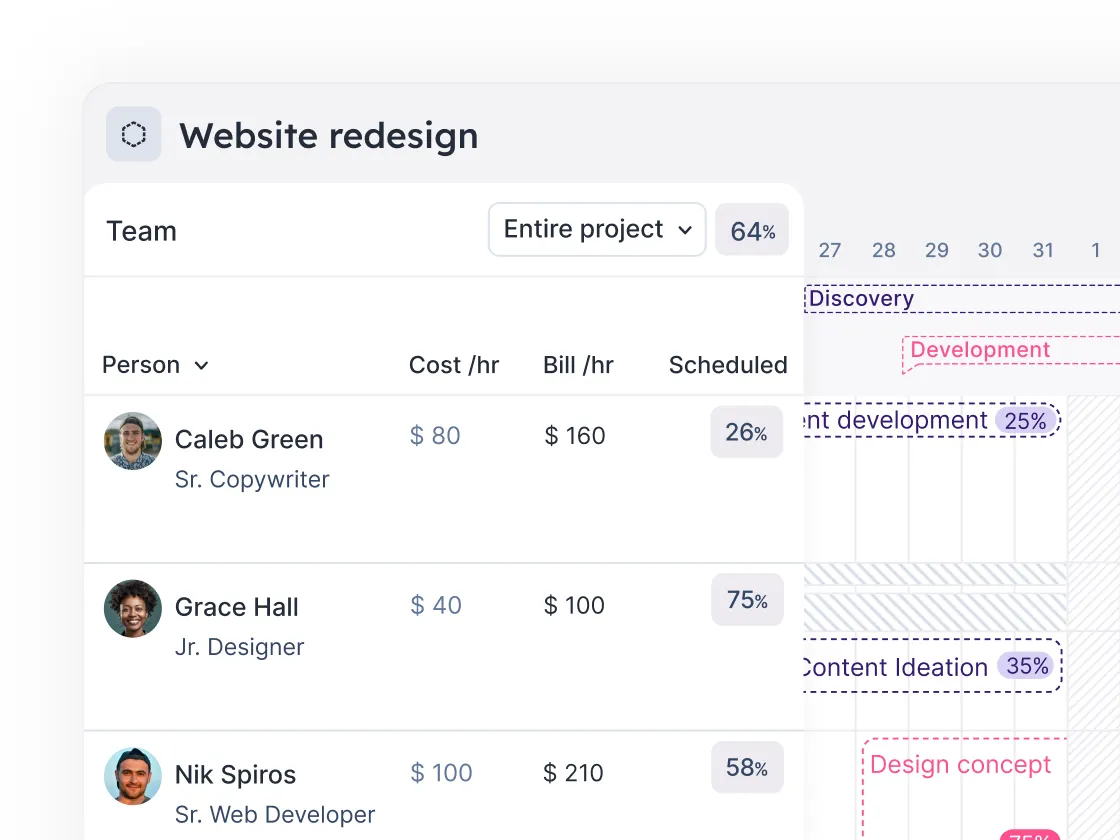
Capability | Build it yourself | Float~Scheduling | Easy to build. This is the 20%. | Built and refined over 15+ years~People & skills | Build the fields; maintain skills, capacity, rates, and history | Structured people data + AI-assisted staffing~Cost & margin | Build the logic; keep rates and actuals current | Real-time cost, margin, and budget tracking~Capacity & utilization | Build and maintain your own reporting | Built-in reporting and forecasting~Connecting your tools | Build each connection to your CRM, finance, PM, and HR | Public API and pre-built connectors (via Zapier)~Keeping them connected | Catch and fix every connection when any vendor changes its API | Maintained by Float~Permissions | Define and maintain your own access model | Built-in role-based permissions~Reliability | Your team handles bugs and edge cases | Float diagnoses and fixes them~Testing | Your team owns regression testing | Continuously tested as the product evolves~Security & compliance | Your team owns security, backups, vulnerabilities, and compliance | Managed as part of the platform~Data portability | Depends on how you architect it | Structured and exportable~Ongoing development | Part of your internal roadmap, forever | Ongoing product investment from Float~Ongoing cost | Engineering + infrastructure + maintenance time; AI token spend | Predictable software cost
</table>
When building your own resource management software makes sense
A vibe-coded or internally built tool can be genuinely good software that reflects your exact workflows and logic. You also get to:
- Control the roadmap
- Keep your data architecture under control
- Avoid traditional per-seat pricing
- Avoid vendor lock-in
It makes the most sense when the scope is small, your workflows are unusually specific, and you have engineering capacity to own the product.
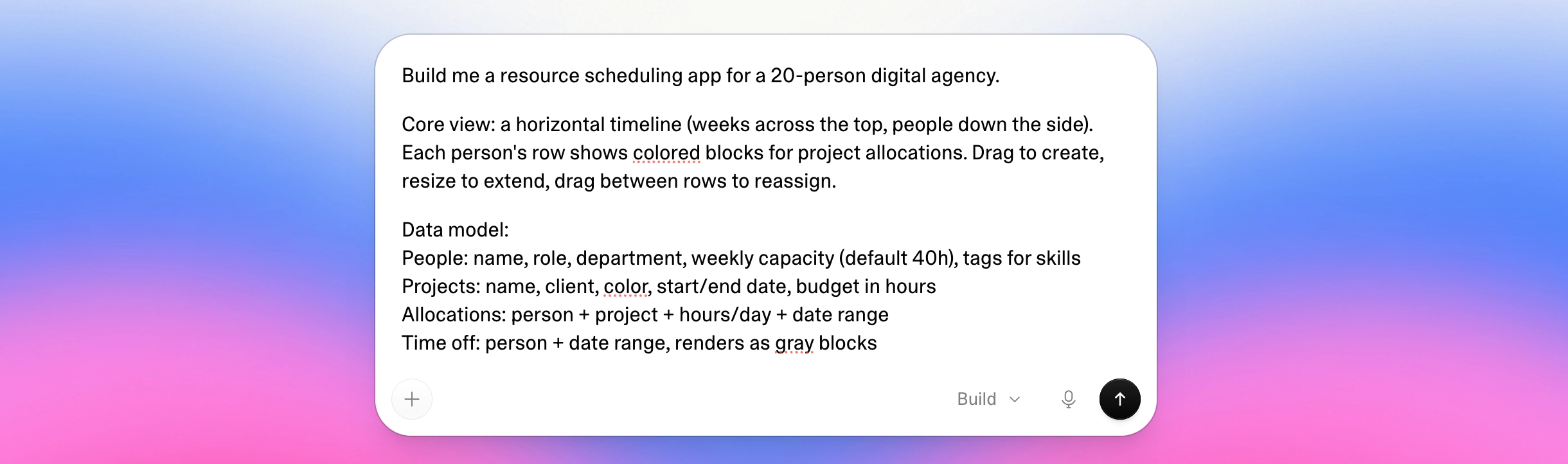
Important note: of course, the above assumes someone is there not only to build it, but also to maintain, update, and fix it over time. If you don’t have an R&D department or engineering resources to spare, “let’s just build it” or even “we’ll vibe-code it” gets a lot less compelling.
The cost of owning your own resource management system
Now consider what changes when your prototype becomes something the business depends on. Suddenly, your team needs to take on the responsibilities of a software company: ongoing maintenance, development, infrastructure, compliance, and operational risk.
- Ownership & maintenance: someone has to own the roadmap, fixes, regression testing, edge cases, and development, and keep the tool moving forward so it continues being useful as your business grows
- Data & security: your team is now fully responsible for permissions, data architecture, security practices, vulnerability management, backups, and a clean way to export data if you eventually move away from this internal system
- Compliance: requirements such as GDPR in Europe and data-deletion obligations aren’t automatically solved because the software is internal: if you hold employee or customer data, they’re now your legal responsibility.
<highlight>None of this means don’t build it—but it does change the math.</highlight> Don’t compare the cost of a monthly software subscription to that of a one-off build: instead, consider the never-ending bill you will pay in engineering, product, infrastructure, and even legal capacity to keep your internal software running.
What Float gives you that an internal build can’t
Your team can build a scheduler; with enough time, maybe the whole suite: integrations, margin logic, permissions, reporting, even a staffing model on your own data.
All of it is buildable. But also: it’s already built, by our team, as well as maintained and improved, without this impacting your roadmap or capacity. This is what you get when you choose Float over a vibe-coded or internally developed solution:
- 15+ years of deep expertise: our product is the result of 15+ years spent learning how professional services and in-house delivery teams plan, forecast, and manage capacity and margin. We’re working alongside some of the largest and most sophisticated companies in the world (check them out), and building with and for teams that operate resource management at an extremely high level.
- Depth: the first version of a vibe-coded tool answers the questions you had when you built it, but it doesn’t answer the ones you’ll have in a year because you don’t know them yet. Float does: we have been dealing with all of the above since 2011, and have been ranked #1 in resource management by G2 for 8 seasons in a row.
- Continuous investment: an internal tool improves when your team chooses to invest in it; with Float, it’s our team who is continuously developing the product, responding to your needs, improving the underlying infrastructure, and expanding what resourcing software can do for you.
- Speed to value: your team might be able to build you a first version quickly; Float gives you the accumulated investment of years of development from day one. You’re starting with a mature product that has already evolved beyond the first version you’d have built yourself, the one you’d rebuild after it, and the three you’d rebuild after that.
Build in-house vs. buy Float?
If you have genuinely simple scheduling needs, highly specific workflows, and an engineer with spare capacity, build it. You might get exactly what you need.
For everyone else, be clear about what you’re taking on. The scheduler is just the starting point; what makes delivery work is everything else underneath it, which needs to be both built and maintained forever. That’s where Float pays for itself.
As your next step, watch this 3-minute product tour to see what you’d be really taking on if you wanted to build it all yourself: scheduling, capacity, people data, and project financials working together in one system.
FAQs
A few quick FAQs, answered:
Yes. Tools like Claude, Cursor, Lovable, and Replit make it possible to build a working resourcing app tool quickly, particularly for straightforward scheduling. But scheduling is only one part of the resource management function: a production-ready system also needs accurate people data, capacity and utilization tracking, real-time financial and margin reporting, integrations, permissions, security, testing, and ongoing maintenance, which are harder to vibe-code and maintain ongoingly.
Building can make sense when your scope is small, your workflows are unusually specific, and you have engineering capacity to own the product. It can give you more control over the roadmap and data architecture, while helping you avoid vendor lock-in and traditional per-seat pricing.
The key is having someone who can maintain, update, test, and fix the system as your business changes.
The initial build is only part of the cost. Once the software becomes something your business relies on, you also take on ongoing engineering and product work, infrastructure, security, backups, vulnerability management, compliance, integrations, testing, and bug fixes.
The real cost is therefore not just what it takes to build the system once, but what it takes to keep it reliable and useful over time.
Not necessarily: comparing an ongoing software subscription with the one-time cost of building an internal tool is misleading. An internal system comes with an ongoing cost for engineering, infrastructure, maintenance, security, compliance, and development. If resource management is business-critical, an established platform will give you those capabilities out of the box, without requiring your team to operate and maintain the software themselves.